The Longevity Industry Is Selling More Than It Is Solving
The longevity industry must move beyond expensive protocols and impressive metrics to demonstrate meaningful improvements in patient health. Dr. Arvind Chakravarthy explores why personalized care, measurable outcomes, and continuous reassessment should define the standard for longevity medicine, not the price of a membership or the complexity of a protocol.
By Dr. Arvind Chakravarthy MD, MBA
By Dr. Arvind Chakravarthy, MD, MBA
The longevity industry has become very good at making healthcare look impressive.
Expensive memberships. Extensive testing. Elaborate protocols. A refrigerator full of products and an app full of numbers.
But ask a patient one simple question, “How has your health actually improved?”, and the answer should be clearer than the invoice.
Too often, it isn’t.
I work in longevity and regenerative medicine because I believe we can do better than waiting for disease to become obvious. That also means I believe our industry deserves scrutiny. If we want to call ourselves the future of medicine, we should be willing to show our work.
Complexity has become a sales strategy
There is a tendency to assume that a complicated protocol must be a sophisticated one.
But every additional intervention should have a reason. What are we addressing? What improvement are we expecting? When will we reassess? What would make us change direction?
If those questions cannot be answered, the patient has purchased activity without a clear strategy.
A premium experience can make care easier and more personal. It cannot substitute for clinical judgment.
And a biological age score moving in the right direction should never become permission to ignore worsening strength, poor sleep, elevated blood pressure, or a patient who still feels terrible.
Patients deserve a definition of success
Before treatment begins, we should agree on what matters.
For one person, that may mean improved glucose control and a smaller waist while maintaining strength. For another, it may mean better sleep, greater exercise capacity, or enough energy to participate fully in family life.
Some outcomes are measurable in a laboratory. Others require listening carefully and tracking function over time. Both belong in the conversation.
Feeling better matters. Understanding whether that improvement is durable and whether treatment is creating problems elsewhere, matters too.
This is why I believe in a closed loop
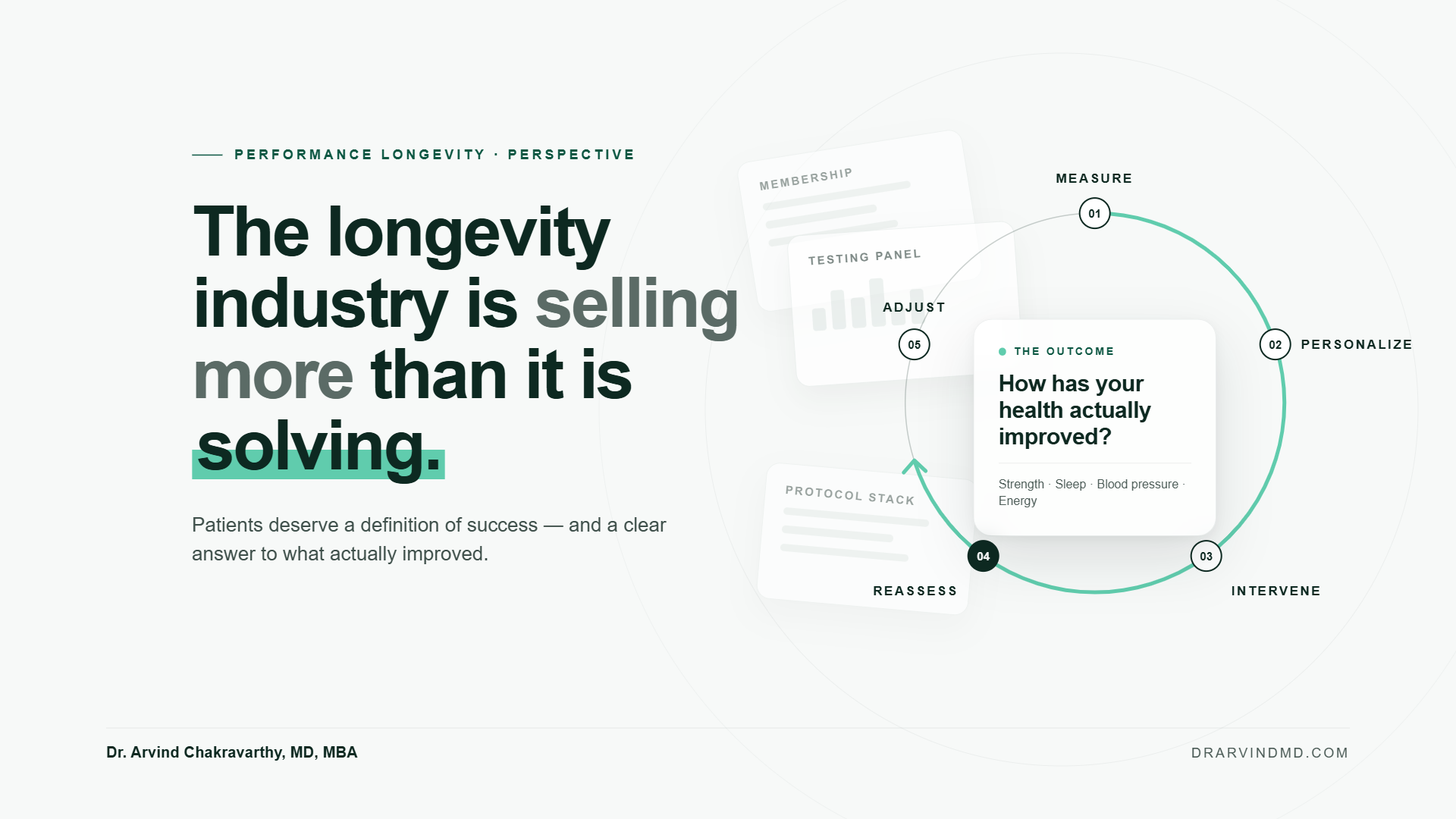
My approach to Cell Signalomics™ and Closed-Loop Regeneration centers on connecting assessment, a defined plan, and reassessment.
Measure. Personalize. Intervene. Reassess. Adjust.
A score can organize a conversation. It should never end one. A protocol should evolve when the patient’s response tells us it needs to evolve.
Sometimes that means adding something. Sometimes it means stopping something. Sometimes the most valuable medical decision is refusing to sell an intervention that adds little.
The industry needs a higher standard
I am comfortable charging for expertise, access, physician time, and meaningful follow-through.
I am much less comfortable with an industry that treats the size of a membership fee as evidence of the quality of care.
Patients should leave with a clear understanding of what improved, what did not, and what comes next.
If we cannot explain the value in plain language, we should question whether we delivered it.
Longevity should earn the patient’s trust at every reassessment. The renewal payment is not the outcome.